Full-Stack Containerization & Multi-Container Networking
Built a modular, containerized web service environment and a multi-container network topology using custom Docker bridge networks and container name resolution.
Business value
For development teams moving software between laptops, test environments and servers, this build removes dependency drift and brittle IP-based configuration. The isolated, repeatable runtime and name-based container networking reduce environment-specific failures and make each deployment easier to reproduce.
The problem
Software frequently breaks when moved across environments due to missing dependencies, conflicting runtimes and inconsistent OS libraries — the classic 'it works on my machine' problem.
What I built
- 01
Wrote structured, layered Dockerfiles using FROM, WORKDIR, COPY, RUN and CMD to create repeatable, cache-efficient builds.
- 02
Built a clean local web application service and wrapped it inside an isolated container runtime.
- 03
Built the image from source, managed container lifecycles, published ports and verified execution locally.
- 04
Created a custom user-defined Docker bridge network and attached independent containers to enable inter-container communication via container names instead of brittle IP addresses.
- 05
Initialized a Git repository, managed branches and configured SSH keys for secure remote authentication and GitHub collaboration.
Project stages
01 / 04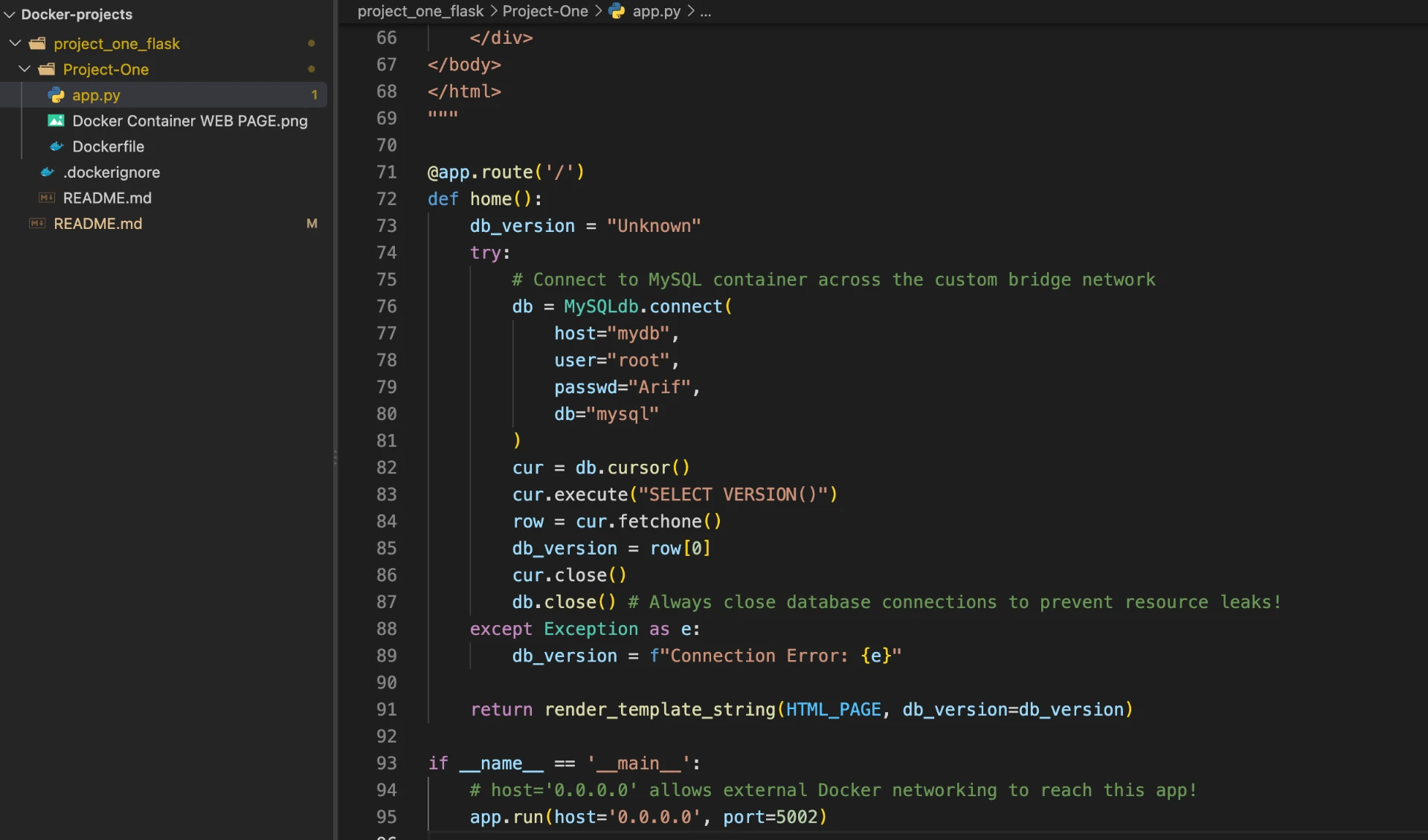
Stage 01 — app.py connecting to the MySQL container by container name (host="mydb") via Docker's internal DNS.