Enterprise Network — TechBridge
Designed, built and tested a full two-site enterprise network for TechBridge Solutions — a London headquarters and a Birmingham branch plus a public site — using a two-tier collapsed core with HSRP gateways, 22 VLANs, VLSM addressing sized for 50% growth, OSPF dynamic routing, NAT/PAT, ACL-filtered DMZs and a GRE-over-IPSec site-to-site tunnel, then validated every design decision with 18 documented tests.
Business value
For a growing two-site business, this design removes single points of failure, fragmented addressing and insecure inter-site traffic. It provides capacity for 50% headcount growth without re-addressing, uses gateway redundancy to minimise downtime, and passed 18 end-to-end validation tests.
The problem
TechBridge Solutions provides secure off-site data storage and recovery, and its existing infrastructure across the London and Birmingham sites could not meet expectations for reliability, scalability, flexibility or security. The network had to support roughly 500 hosts per department in London and 200 in Birmingham while absorbing 50% growth over two years without a redesign, keep departmental traffic isolated, survive the loss of a core switch without downtime, expose public-facing servers safely, and connect both sites privately rather than across the open internet.
What I built
- 01
Chose a two-tier collapsed core (core and distribution combined into layer 3 switches) to cut latency, simplify management and match the scale of a medium-sized organisation, with redundant core switches at each site.
- 02
Configured HSRP across the core switches so every VLAN has a single virtual gateway IP with an automatic standby, removing the core switch as a single point of failure.
- 03
Sized the addressing with VLSM: Class C 192.168.x.x /22 in London (1,022 usable hosts per VLAN against a 750-host requirement) and Class B 172.16.x.x /23 in Birmingham (510 hosts against 300 required), with /30 links for every WAN transit hop to avoid wasting addresses.
- 04
Segmented London into 8 departmental VLANs plus a DMZ and management VLAN, and Birmingham into 10 VLANs plus DMZ and management, keeping broadcast domains small and departments logically isolated.
- 05
Ran OSPF internally and externally for dynamic route discovery and redundant paths, backed by static default routes on the WAN routers pointing to each ISP (PlusNET for London, O2 for Birmingham).
- 06
Built a GRE tunnel protected by IPSec VPN policies between the two sites, so inter-site traffic is encrypted and separated from the public internet.
- 07
Centralised addressing with DHCP servers per site and DHCP relay (IP helper) on the layer 3 switches, so every VLAN leases addresses, masks and HSRP gateways automatically.
- 08
Applied NAT/PAT overload on the edge routers so thousands of internal devices share a single public IP, and ACLs (including ACL 190) to permit only HTTP and ICMP into the DMZ servers.
- 09
Hardened device access with SSH-only management, MOTD banners and a dedicated management VLAN; secured wireless with WPA2-PSK/AES and per-VLAN SSIDs on non-overlapping channels 1, 6 and 11.
- 10
Selected and justified hardware: 2811 routers at the WAN edge for NAT, OSPF and IPSec; 3650-24PS layer 3 switches as the collapsed core for inter-VLAN routing, HSRP and relay; 2960 access switches for VLAN tagging and redundant trunks.
- 11
Validated the build with 18 tests covering SSH access, site-to-site reachability, end-to-end PC traffic, HSRP failover state, DHCP leases, NAT translations, STP convergence, inter-VLAN routing, wireless association, IP helper behaviour, OSPF tables and IPSec security associations before and after traffic.
Project stages
01 / 30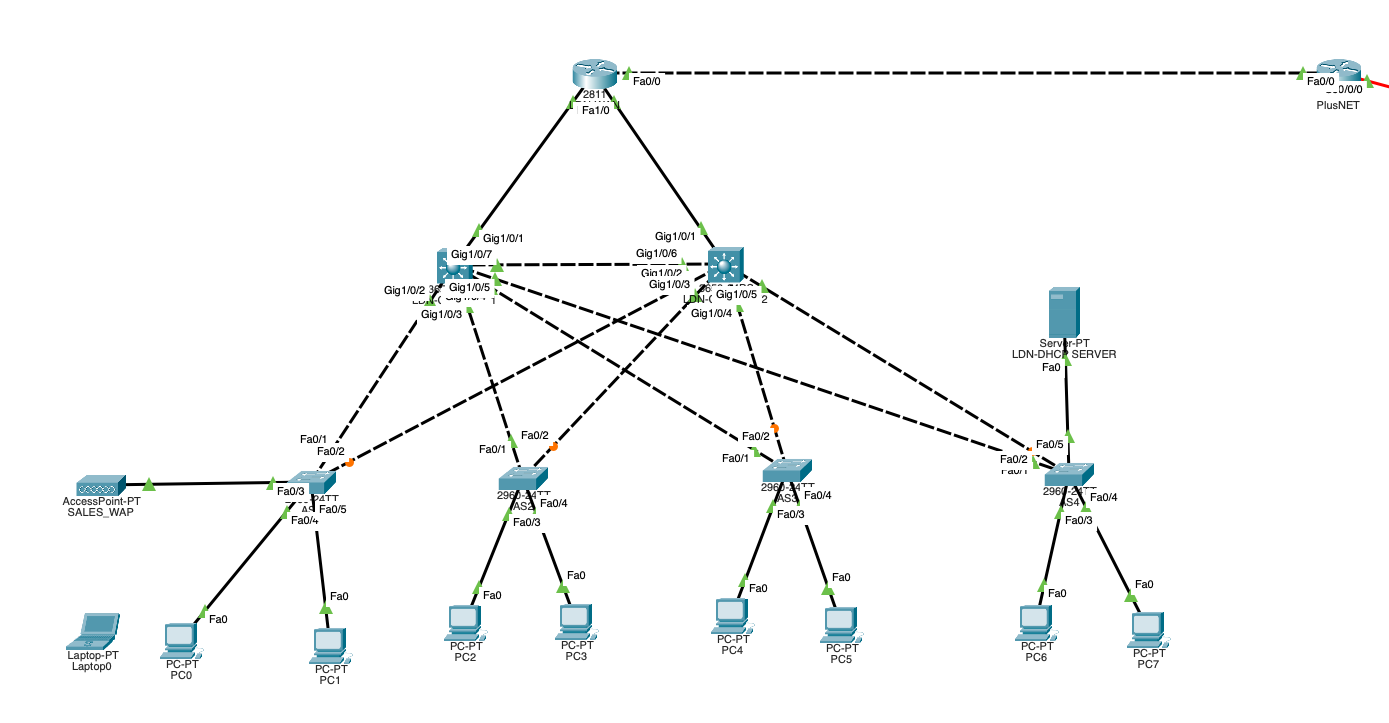
Headquarters architecture — two-tier collapsed core in London, with redundant layer 3 core switches running HSRP for a single resilient gateway.